Updated: July 2026
Phinisi vs Catamaran: Which Labuan Bajo Boat Charter is Best?
- Choose a Phinisi for: Authentic cultural immersion and expansive social deck space.
- Choose a Catamaran for: Speed, superior stability, and access to shallow coves.
- Both offer: Superb luxury, private en-suite cabins, and gourmet dining.
The Flores Sea is a sheet of cobalt silk, disturbed only by the gentle wake of your vessel. The air, thick with the scent of salt and sun-baked volcanic rock, carries the distant cry of a sea eagle. Ahead, the saw-toothed peaks of Padar Island rise like ancient titans from the water. This is the daily reality of exploring Komodo National Park, and the most critical decision you’ll make is not if you go, but how. As a travel editor who has spent years chronicling the world’s most exclusive maritime journeys, I can attest that the vessel is the destination. In these waters, the debate invariably comes down to two magnificent, yet philosophically different, options: the soulful Indonesian Phinisi and the sleek, modern catamaran. Choosing between them defines the very texture of your adventure.
The Soul of the Archipelago: Understanding the Phinisi Legacy
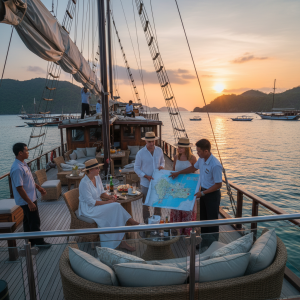
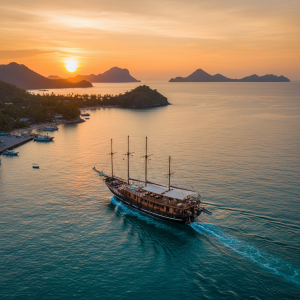
To step aboard a Phinisi is to step into a living narrative. These majestic wooden ships are not mere boats; they are the physical embodiment of Indonesia’s maritime soul. Their lineage traces back to the Bugis and Makassarese people of South Sulawesi, master seafarers who have navigated the archipelago’s 17,000 islands for centuries. The art of Phinisi boatbuilding is so culturally significant that it was inscribed on UNESCO’s list of Intangible Cultural Heritage of Humanity in 2017. The construction itself is a ritual, traditionally done without blueprints, relying on generational knowledge passed from father to son. The keel is laid in a ceremony, and the hull planks are joined using a technique that predates Western methods by centuries. Modern luxury Phinisis, like those in our curated selection of vessels, are built from formidable local timbers like ironwood (kayu ulin) for the hull and teak for the decks, often taking over 18 months to complete. Onboard, the ambiance is one of handcrafted elegance and history. The creak of the timbers, the vast, open decks designed for communal living, and the towering masts create an atmosphere of romantic, old-world exploration that a contemporary yacht simply cannot replicate. It is a slower, more deliberate way to travel, where the journey itself is as profound as the destination.
Modernity on Twin Hulls: The Allure of the Catamaran
If the Phinisi is a floating cultural artifact, the catamaran is a marvel of modern naval engineering, designed for performance, comfort, and efficiency. Where the Phinisi features a deep, single hull, the catamaran’s defining feature is its twin-hull design, which provides a level of stability that is immediately noticeable. In the occasionally choppy channels between Komodo’s islands, this translates to a smoother ride with significantly less roll, a major advantage for guests prone to seasickness. This stability also means the vessel remains almost perfectly level when at anchor, turning a secluded bay into a tranquil, private platform for swimming, dining, and relaxing. Constructed from lightweight composite materials like fiberglass, catamarans are faster and more nimble than their wooden counterparts. A typical cruising speed of 8-10 knots, compared to a Phinisi’s 5-7 knots, can effectively add an extra snorkeling site or island visit to a day’s itinerary. Perhaps their most significant practical advantage in Komodo is their shallow draft. They can safely navigate into bays and anchor closer to beaches that a deep-keeled Phinisi must avoid, granting unparalleled access to the park’s most secluded corners. The experience is less about historical romance and more about sophisticated, seamless access to nature.
Onboard Experience: Space, Comfort, and Ambiance
The fundamental design differences between these two vessels create distinct living environments. A luxury Phinisi, which can range from 30 to over 50 meters in length, is often characterized by its vast, open-air main deck. This is the heart of the ship—a sprawling space for alfresco dining, morning yoga sessions, and evening cocktails under a canopy of stars. The interior spaces exude a warm, colonial charm with polished wood, brass fittings, and local textiles. Cabins are typically located below deck, offering cozy, well-appointed sanctuaries, though newer builds are incorporating master suites on the main or upper decks. The overall feeling is communal and expansive, encouraging interaction among guests. In contrast, a catamaran’s space is distributed horizontally. Its wide beam, often 8-10 meters, creates an enormous, single-level living area that seamlessly connects the indoor salon with the aft cockpit. This open-plan layout is perfect for families. The iconic netting or “trampoline” at the bow becomes a coveted spot for sunbathing while underway. Cabins are situated within the two separate hulls, offering a greater degree of privacy and separation than on many Phinisis. For those who value personal space and a bright, airy, contemporary aesthetic, the catamaran’s layout is hard to beat.
Navigating Komodo’s Waters: Performance and Itinerary Flexibility
Komodo National Park, a 1,733-square-kilometer protected area, is a dynamic environment with powerful currents that can exceed 8 knots in channels like the Lintah Strait. How a vessel performs in these conditions directly impacts your itinerary. The inherent speed and maneuverability of a catamaran provide a distinct advantage in maximizing your time. The journey from Labuan Bajo to the heart of the park, near Rinca or Padar Island, is roughly 25-30 nautical miles. A catamaran might cover this in 3 hours, while a Phinisi could take 5 hours. This time-saving can mean the difference between a rushed afternoon trek and a leisurely exploration followed by a sunset snorkel. The catamaran’s agility allows for quick changes of plan; if one dive site is crowded, moving to another is a faster, simpler affair. However, to view this purely through the lens of efficiency is to miss the point of the Phinisi. The slower pace of a traditional vessel is a feature, not a bug. It forces a more mindful immersion into the landscape. The longer transit times become part of the experience—a chance to read, watch for dolphins, or simply absorb the epic scale of the volcanic scenery. A well-planned labuan bajo yacht charter on a Phinisi is not about rushing between waypoints but about savoring the majestic progression through one of the world’s great natural wonders, as detailed by Indonesia’s official tourism board.
The Crew and Service Dynamic: A Tale of Two Philosophies
Beyond the hardware of the vessels lies the software: the crew. The human element is paramount in any luxury charter, and here again, Phinisis and catamarans often present different service cultures. The crew of a Phinisi is almost invariably Indonesian, many of whom are from the same Bugis seafaring communities that have sailed these waters for generations. The captain’s knowledge is often innate, a deep, instinctual understanding of the winds and currents. The service style is typically warm, intuitive, and familial. It feels less like a formal crew and more like you are being hosted by a proud family eager to share their culture and home. The cuisine is often a highlight, focusing on authentic, masterfully prepared Indonesian dishes. On a luxury catamaran, the crew may be more international, comprising a European skipper, a South African divemaster, and a Balinese chef. The service might feel more aligned with global superyacht standards—polished, professional, and perhaps a bit more formal. This is not a question of which is better, but a matter of personal preference. Do you seek the warmth of authentic, local hospitality, or the refined polish of an international five-star resort? As one charter specialist, Jean-Marc Hergas, once told me, “The Phinisi sells a story. The catamaran sells a function. Both deliver luxury, but they speak different emotional languages.” Our team of expert charter curators can help you decipher which language speaks to you.
Quick FAQ: Phinisi vs. Catamaran for Your Komodo Trip
Which vessel is better for families with young children?
Generally, the catamaran is the preferred choice. Its superior stability minimizes the risk of seasickness, and the wide, flat decks with surrounding safety lines and nets are safer for little ones. The easy access to the water from the low stern “sugar scoops” is also a major plus for swimming and water sports.
Which is better for large groups or multi-generational families?
This depends on the group’s dynamic. A Phinisi, with its enormous single main deck, is exceptional for keeping a large group together in one social space. It fosters a communal atmosphere perfect for milestone celebrations. A catamaran, with its multiple separate relaxation zones (cockpit, salon, bow trampolines), allows a large group to spread out and find personal space, which can be crucial on a longer trip.
Which is the more sustainable or eco-friendly choice?
Both modern Phinisis and catamarans rely on diesel engines for propulsion, as sailing is often impractical due to winds and currents in Komodo. However, sustainability can be viewed through a cultural lens. Chartering a Phinisi directly supports the continuation of a unique, UNESCO-recognized boatbuilding tradition and provides employment for local Bugis sailors, preserving invaluable cultural heritage.
Do both have modern amenities like air conditioning, en-suite bathrooms, and Wi-Fi?
Yes. On any vessel within the luxury segment, whether it’s a Phinisi or a catamaran, you can expect all the modern comforts. All cabins will have private en-suite bathrooms and individual air-conditioning controls. While Wi-Fi is available via satellite, it’s important to set expectations; connectivity in the remote corners of the park can be intermittent and is best for essential communication, not streaming.
Ultimately, the choice between a Phinisi and a catamaran is a choice between two different dreams of paradise. One is steeped in history, heritage, and the romance of sail; the other is a testament to modern design, stability, and performance. There is no single “best” option, only the one that is best for you. Consider your priorities: Are you drawn to the cultural narrative and grandeur of a traditional schooner, or do you value the speed, stability, and private spaces of a modern multi-hull? Either way, you are unlocking the door to an memorable expedition through a land that time forgot. To discover the vessel that perfectly aligns with your vision, begin by exploring our labuan bajo yacht charter portfolio and allow our specialists to craft your bespoke Komodo journey.